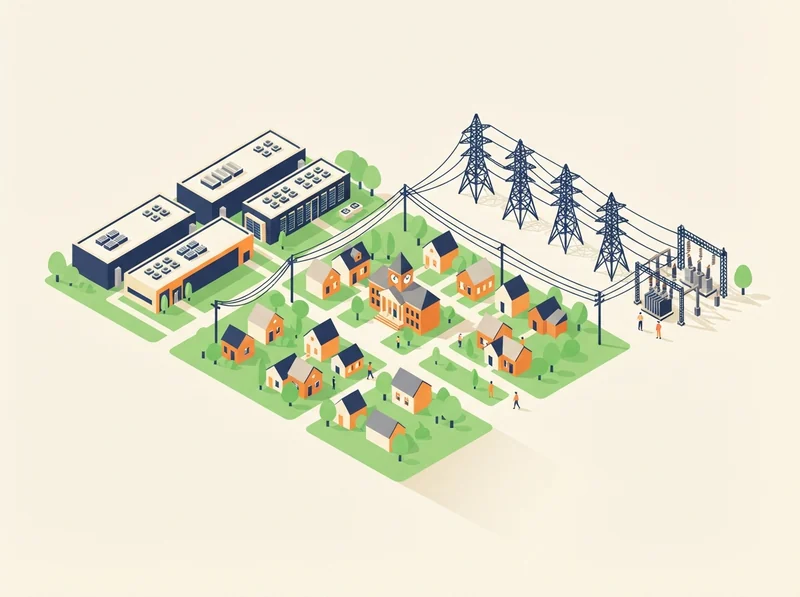
We’re about to find out.
The unstoppable force is the AI industry — OpenAI, Google, Anthropic, Microsoft, Amazon, Nvidia, SpaceXAI — companies collectively committing hundreds of billions of dollars to computing infrastructure, operating on timelines measured in months, backed by the most aggressive capital deployment in the history of technology.
The immovable object is the American electric grid — a system planned in decades, regulated in years, and run by institutions that, until very recently, hadn’t seen meaningful demand growth in a generation.
The collision between them is the single most important story in energy right now. It’s also the least well understood — including, in my experience, by many of the people approving data center projects and many of the people opposing them. So let’s talk about how we got here.
How we got here: the grid that forgot how to grow
For most of the twentieth century, American electricity demand grew steadily, and the system grew with it. Utilities built power plants, strung transmission lines, and earned a regulated return on every dollar of infrastructure. Growth was the business model.
Then, sometime in the mid-2000s, growth stopped.
For nearly two decades, US electricity consumption was essentially flat. Population grew, the economy grew, but demand didn’t — because energy efficiency quietly cancelled everything out. LED lighting, better appliances, tighter building codes, and an economy shifting from manufacturing to services meant that every new source of demand was offset by doing more with less.
This was, to be clear, a triumph. Efficiency is the cheapest power plant ever built. But it had a side effect nobody intended: an entire industry lost the muscle memory of growth.
Utilities stopped planning for big new loads. Regulators stopped approving them. Transmission investment lagged. Whole careers were built in a world where the demand forecast was a flat line — and where the most important skill was managing decline gracefully. The institutions didn’t become lazy or stupid. They became exquisitely adapted to a world that no longer exists.
A permitting process from another era
Nowhere is the mismatch more visible than the interconnection queue — the process by which new power plants get permission to connect to the grid.
This process was designed for a different era: a handful of large, conventional power plants, each studied one at a time, in sequence, with each study potentially triggering redesigns of the studies behind it. First come, first served, no matter how speculative the project.
Here’s what that system produced. At its peak in 2023, the queue held nearly 2,600 gigawatts of proposed generation and storage — roughly double the capacity of the entire existing US grid, all waiting in line. It has since thinned to about 2,000 gigawatts, mostly because projects gave up and withdrew. The median project that finally connected in 2025 waited more than five years from request to operation — up from under two years in the mid-2000s. And the overwhelming majority of projects that enter the queue never get built at all.
Read that again: our process for adding power to the grid has a success rate that would embarrass a lottery.
To be fair, much of what’s in the queue was never real — speculative reservations by developers squatting on a spot in line. But that’s the point. A process that can’t distinguish serious projects from placeholders isn’t a process. It’s a waiting room.
Meanwhile, the force arrives
Into this system walks AI.
Data centers consumed about 4–5% of US electricity in 2024. The Department of Energy’s own analysis projects that figure could approach 12% by 2030 — with plausible scenarios ranging from 9.5% to over 15%. The IEA expects data centers to drive roughly half of all US electricity demand growth through the end of the decade. After two decades of flat, total consumption is now growing at more than twice the rate of the past ten years.
And it’s not just the scale. It’s the shape. A modern AI campus can demand a gigawatt or more — the output of a nuclear reactor — delivered to a single site, on a two-to-three-year timeline, in a specific location chosen for fiber, land, and incentives rather than for where the grid happens to be strong.
The utility planning cycle that receives this request? Integrated resource plans refreshed every few years. Transmission projects that take a decade. Regulatory proceedings measured in geological time. The AI industry runs on eighteen-month chip cycles. The grid runs on eighteen-year infrastructure cycles. Both sides now sincerely believe the other is being unreasonable.
The regulators caught in the middle
It would be easy to cast regulators as the villains here. Resist that temptation.
Public utility commissions exist to protect ratepayers, and right now that’s a genuinely hard job. If a commission lets a utility build billions in new infrastructure for a data center that never materializes — or that leaves in five years — ordinary households eat the cost for decades. If it moves too slowly, the investment, jobs, and tax base go to the next state over. Every tool they have — cost allocation, rate design, demand forecasting — was built for the flat-demand world too.
And the AI companies face their own regulatory vacuum: there is no federal framework for the technology, no coherent national policy on the infrastructure behind it, and fifty different state regimes for the power it needs. The force is unstoppable partly because nothing has been built to channel it.
So the dysfunction isn’t a story of bad actors. It’s a story of institutions on both sides designed for a world that ended — colliding with a future that arrived early.
What actually gives
The physics riddle has a real answer: in physics, “immovable” and “unstoppable” are the same property viewed from different frames — so two such objects would simply pass through each other, each unchanged.
The grid and AI will not pass through each other. Something gives. The only question is what, and who pays for it.
Three things are already starting to give:
The queue is being rebuilt. FERC’s 2023 reforms started replacing first-come-first-served with cluster studies and readiness requirements. It’s slow, partial, and years from done — but the direction is right: a line for serious projects, not a waiting room for speculators.
The “bring your own power” era has begun. Unable to wait five years, AI companies are going around the grid — on-site generation, behind-the-meter deals, direct purchases from power plants, revived nuclear reactors. This relieves the queue but raises hard questions: when the biggest customers leave the shared system, who pays for what’s left behind?
And the fight is moving to the last place either industry wanted it: your town. When the queue is full and the commission is slow, the de facto permitting process for AI becomes the zoning hearing. The immovable object and the unstoppable force are meeting in church basements and county commission rooms — in front of people who didn’t design the grid, didn’t build the models, and are being asked to absorb the collision anyway. Which means the most consequential energy proceedings in the country are now being run by volunteer boards with no staff, no budget, and no process built for the job.
Why this is my work
This is the part of the story I know best, and it’s why I started CommonWatts.
Every macro failure in this piece — the queue, the planning cycles, the regulatory lag — lands eventually on a specific piece of land next to specific neighbors. A community gets told the project is essential for national competitiveness, the power will be there, the jobs will be real, the bills won’t go up. Sometimes that’s true. Sometimes it isn’t. Almost nobody in the room is equipped to tell the difference.
So I don’t take a side. I run one process for both sides — the same facts, jointly checked, and terms written down where everyone can read them — on fees that are fixed, published up front, and never contingent on whether a project gets approved. That last part isn’t a virtue signal. In a room this distrustful, a facilitator whose paycheck moves with the vote is just one more interested party holding a whiteboard, and everybody in the third row can tell.
For developers: the grid’s dysfunction is now your community-relations problem. “We’ll figure out the power” is not an answer that survives a public hearing in 2026. The projects that win will be the ones that arrive with credible power plans, honest timelines, and benefit agreements that account for what the grid can’t promise.
For communities: the questions to ask have changed. Not just “how much water” and “how many jobs,” but: where does the power actually come from, what happens to our rates if the load never shows up, and what protections exist if the unstoppable force stops?
The riddle assumes the collision is instantaneous. Ours won’t be. It will play out over years, in queues and commissions and town halls — one interconnection agreement, one rate case, one zoning vote at a time.
Which means the outcome isn’t physics. It’s a choice. And right now, it’s being made by whoever shows up.